Overview

Reptiles of Ranthambore

Ranthambhore supports an exceptionally rich reptile fauna, with nearly 63 species recorded to date. They include crocodiles, turtles, tortoises, lizards and a remarkable diversity of snakes, making the reserve one of the most important reptile habitats in north-western India.

Snakes

A total of 32 snake species have been documented from Ranthambhore, ranging from tiny burrowing species to large rock pythons. The reserve supports all four of India's medically important venomous snakes.

In addition to these, numerous harmless species occur throughout the landscape, including rat snakes, keelbacks, bronzeback tree snakes, sand snakes, kukri snakes and pythons. The Indian Rock Python (Python molurus) is the largest snake found in Ranthambhore, while several species of blind snakes, including the Brahminy Blind Snake (Indotyphlops braminus), represent the smallest members of the reptile community. The Checkered Keelback (Fowlea piscator) is the most commonly encountered aquatic snake and is frequently seen around lakes and marshes. It is an important prey species for birds of prey such as the Crested Serpent Eagle.

Indian Cobra (Naja naja)
Common Krait (Bungarus caeruleus)
Russell's Viper (Daboia russelii)
Saw-scaled Viper (Echis carinatus)

Lizards

So far, a total of 18 lizard species from various groups have been recorded. The Indian Monitor (Varanus bengalensis), the largest among them, is the most widespread large lizard in Ranthambhore. The Desert Monitor (Varanus griseus) occurs mainly in the sandy habitats associated with the Banas River and adjoining semi-arid landscapes, and it is very rare. Oriental Garden Lizard (Calotes versicolor) is abundant throughout the reserve and is frequently observed basking on shrubs, rocks and tree trunks.

Crocodilians of Ranthambhore

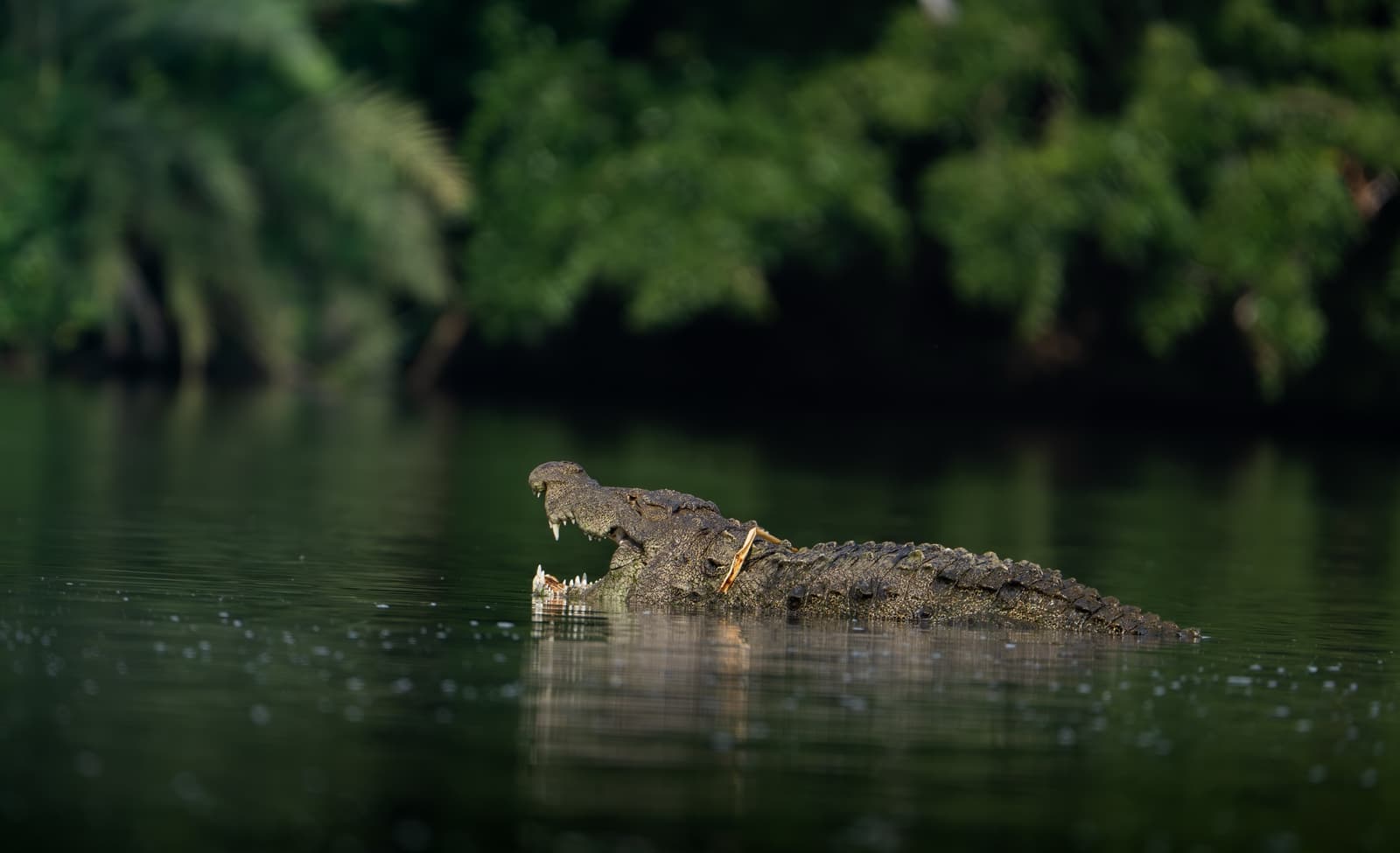
The Marsh Crocodile (Crocodylus palustris), locally known as the Mugger, is undoubtedly the most conspicuous reptile of Ranthambhore. It inhabits almost every major lake and reservoir within the reserve and has established a thriving breeding population.

The Gharial (Gavialis gangeticus) is one of the world's most remarkable and distinctive crocodilians. Instantly recognisable by its exceptionally long, slender snout, it is specially adapted for catching fish and feeds almost exclusively on them. Because of this specialisation, the Gharial survives only in clean, deep, and undisturbed river systems. Nearly 70% of the world's wild gharial population is found in the Chambal River and its associated river system.

Marsh crocodile basking at a Ranthambhore lake

Turtles & Tortoises of Ranthambhore

Three species of freshwater turtles are commonly encountered in Ranthambhore. The Indian Flapshell Turtle (Lissemys punctata) and the Indian Tent Turtle (Pangshura tentoria) are regular inhabitants of the lakes and ponds, while the larger Indian Softshell Turtle (Nilssonia gangetica) also occurs and is occasionally preyed upon by tigers during periods of low water. The Indian Star Tortoise (Geochelone elegans) is one of the rarest reptiles in the landscape, seen only occasionally, usually during or just after the monsoon.

The adjoining Chambal River, however, is home to one of the world's richest assemblages of freshwater turtles. It supports several globally threatened and highly elusive species that are extremely difficult to observe in the wild, including the Red-crowned Roofed Turtle (Batagur kachuga), Three-striped Roofed Turtle (Batagur dhongoka), Narrow-headed Softshell Turtle (Chitra indica), and the Indian Softshell Turtle.